
My vote on eating it? No thank you. It’s too expensive for me . . . in more ways than two.
SPAM® more expensive than sirloin steak?
I read an interesting article the other day in the Statesman Journal about what American consumers are buying and not buying these days. House paint, plumbing repair parts and SPAM are among the things enjoying higher sales. “Hormel said sales of its meat-in-a-can continued to rise in the quarter, gaining in the low double digits.”
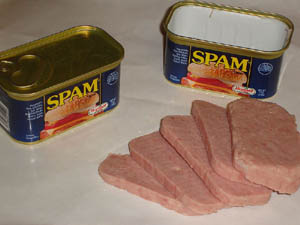
I haven’t seen a can of SPAM in decades but today, just for the heck of it, I ventured into the interior of a local grocery to see what these great sales figures were about. The common belief is that this is an affordable “meat” in “these tough economic times.” It’s at least 10% more desirable than it was in the last fiscal quarter. Baloney and horse manure!
SPAM was offered in three sizes and one of them was on sale. Depending on the size package, today at the Port Hadlock, WA, QFC, you can buy SPAM BY THE POUND for:
- $3.99
- $6.16
- $8.50
I escaped the interior and went back to my more familiar territory, the perimeter of the grocery store, and checked out the meat sales. (I almost always and only buy things on sale.) I found:
- Petite Boneless Sirloin Steak, $3.99 a pound (on sale from its regular 6.99 a pound)
- Boneless Pork Sirloin Chops, $3.99 a pound, buy one, get one free. That makes it close to $2 a pound if you choose your packages carefully.
Last week when I was walking by the meat counter I snagged some skinless, boneless chicken breasts, not organic but no hormones and vegetarian-fed, on sale for $1.99 a pound. I bought two packages and they’re in the freezer.
Let’s look again:
SPAM®:
$3.99
$6.16
$8.50
PER POUND
BONELESS SIRLOIN STEAK, SIRLOIN PORK CHOPS AND CHICKEN BREASTS:
$3.99
$2.00
$1.99
PER POUND
Okay, so let’s blow Myth #1 away. SPAM IS NOT CHEAP! IT’S NOT A “MORE AFFORDABLE” OPTION.
As for Myth #2, that it’s “convenient,” let’s look at the three cuts of meat I named. All of them can be quickly sauteed (like SPAM) just after you take them from the package. There aren’t even any bones. And all three make fabulous, quick, stir fries.”PREPARING” SPAM IS NOT MORE CONVENIENT THAN PREPARING BONELESS REAL MEAT AND POULTRY UNLESS YOU EAT IT STRAIGHT OUT OF THE CAN.
Granted, you can’t store steak, pork chops or chicken breasts in the cupboard, but refrigeration is common in North America.
Marilyn’s Zucchini Chocolate Cake simple style
That last post was long. My recipes are short. Here’s my Zucchini Chocolate Cake recipe card, 25-years-old, well loved and well stained.
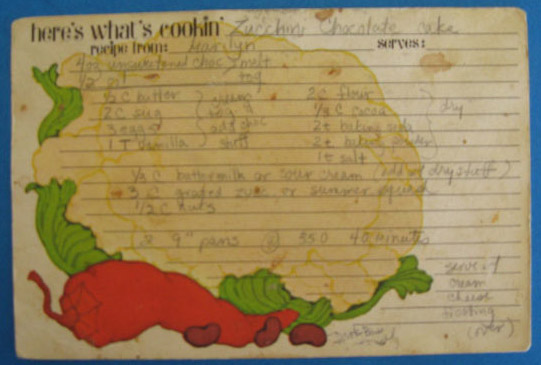
And here it is in pdf form, a quick and easy download for your computer. Enjoy! And understand that to interpret the quick and easy notation you need to know the general process of how to bake a simple cake.
The zucchinis are coming . . . let them be cake
I just finished typing up a recipe to send to the woman who’s in charge of programs for the new Snohomish Knitters Guild. I’ll give my “Knitting, S.E.X., Chocolate, and a Couple of Math Skills” class/presentation at their October 13 meeting. I’m responsible for the hand-outs. They’re responsible for the chocolate. They can provide it in any form, but I send along a few of my favorite recipes in case anyone is inclined to bake. Today I added my friend Marilyn’s Chocolate Zucchini Cake to the mix.
It occurred to me that since the zucchinis are starting their annual invasion of the northern hemisphere, you might enjoy having this recipe as well. Australian and South African readers can bookmark this for the time when the invading hordes migrate their way.
An introduction to cakes
Cakes are easy to make. Recipes . . . not always easy to read. So I streamlined the process by thinking about it differently. I know this is a long explanation, but once you have the process down, you can make a cake about 3 times faster than if you laboriously follow most recipes.
You have basically 3, maybe 4, categories that go into a cake:
- A bowl of dry ingredients.
- A bowl with the fat (butter or oil), sugar and eggs that you “cream together.”
- A liquid of some sort that’s usually not much so you can hold it in a measuring cup. (I use a one or two cup liquid measuring cup.)
- You might have some solid things like nuts to add in at the end.
When I lived with “the guys” (a couple of husbands and a son, not all at the same time) I baked lots of cakes. This was my procedure:
- The night before I was going to bake I’d put the dry ingredients into a two to three quart bowl. For almost every cake, these are the same: flour+salt+baking soda and/or baking powder. A few other powders that might be included are unsweetened cocoa for a chocolate cake and some spices like cinnamon and cloves for a pumpkin or carrot cake. Take a fork or a whisk and gently stir them together so that everything is evenly distributed. Be gentle but thorough. Always put love into your food during the preparation.
- Put the butter in a slightly larger bowl so that it can come to room temperature overnight. I’ve already referred to the fact that I’m over-the-top in love with Challenge Unsalted Butter. That’s what I use. The recipe calls for oleo or margarine? I use my beloved butter. I store it in the freezer because unsalted butter is more perishable than salted. It needs a while to reach temperature and I leave it in its wrapping until it’s time to “cream” it.
- Set out the number of eggs you’ll need. Put them in a bowl on the counter so that one doesn’t roll off and splat on the floor.
- Measure out the “wet” ingredients in a cup. It’s usually milk or buttermilk, occasionally water.
- Go to bed and get a good night’s rest. Your ingredients are adjusting to room temperature in preparation for their willing sacrifice to your palate.
Show Time!
The above part of the preparation was the Zen part of cake-baking, but when it’s time to put it all together you need to get on with it. Making a cake is an exercise in chemistry and once you start the next part of the process you need to move faster.
- Grease the pan(s) and turn on the oven, usually to 350º.
- Cream the butter. That means beat the heck out of it with an electric hand mixer (my tool of choice), full-sized mixer or wooden spoon. Using a spoon takes a lot of time and considerable arm strength, but I’ve done it. You’re getting the butter soft and incorporating air into it.
- Add the sugar a little at a time (about 4 different additions) to the butter and keep beating it. You’re fluffing it up some more.
- Add the eggs, one at a time, and beat after each addition. If the recipe calls for vanilla or some other extract I add it somewhere along in here.
Actually, you don’t have to hurry this creaming part. And this is the last time you’re allowed to “beat” anything vigorously. The reason is this: you don’t want your cakes to be tough. When you bake bread you knead the dough for a long time. This heavy treatment develops the gluten in the flour and that’s what gives bread it’s chewiness. It also helps to develop those good-sized holes.
Cakes are meant to be tender and you want to treat the addition of the flour mixture more carefully because you don’t want to develop the gluten.
You now have five additions to make to your creamed mixture. After each one you will stir/beat the ingredients just until they’re incorporated (i.e. you can’t see any more powdery stuff or loose liquid). They are:
- 1/3 of the dry ingredients
- 1/2 of the liquid ingredients
- 1/3 of the dry ingredients
- 1/2 (the rest of) the liquid
- 1/3 (the rest of) the dry ingredients
You don’t have to measure these exactly. Just eyeball them. And because now you’ve combined the baking powder and or baking soda with the liquid which often is acidic, you have a chemical reaction going on. The bubbles are starting to form and you want to get it in the oven soon.
Your last addition is any nuts, raisins or chocolate chips or other tasty morsels. Fold them in gently, trying to get them pretty evenly distributed but precision is not necessary for deliciousness.
Put the batter in the pan(s) and place the pan(s) in the oven and don’t you dare open that oven until more than half of suggested baking time has elapsed or even longer. Otherwise your cake might “fall.”
A few more miscellaneous details . . .
- Don’t do the jig in front of the oven or drop heavy things on it or jiggle the cake while it’s baking. Otherwise, your cake might fall (see above).
- When making a cake, measure your ingredients carefully. This is probably the only circumstance in which I do this because it’s chemistry (and alchemy but we won’t go there).
- If I use a 13″ x 9″ pan and I’m going to leave the cake in the pan after it’s cooled and cut the pieces out of there, I just grease the pan. If I use a pan (or pans) and want to take the cake out after about ten minutes of cooling, I grease the pans and then line the bottom with parchment paper I’ve cut to size. Waxed paper will do.
Finally!!! Marilyn’s Chocolate Zucchini Cake
Oh so moist. Not very sweet but definitely a heavy chocolate hit. And, of course, sinlessly good for you because of the zucchini.
Before you even turn on the oven or grease the pans, melt together in a small bowl in the microwave:
4 oz unsweetened chocolate
1/2 cup of neutral-tasting oil like canola
Be careful. Do it in one minute intervals and stir it in between them. The oil heats up quickly and the chocolate squares will continue to melt as you stir. You don’t want to scorch it. You will add this to the creamed ingredients after all the eggs are beaten in. Let this cool down before you add it to the fat ingredients because you do not want to melt your butter or cook your eggs!
The dry stuff:
1 Cup flour
1/3 C unsweetened cocoa (Droste or Equal Exchange Organic are good brands. Ixnay on the most common grocery store brand. It’s bitter and tastes burnt to me . . . chemical processing . . . not so tasty.)
2 t baking soda
2 t baking powder
1 t salt
The wet stuff:
1/3 C buttermilk or sour cream (if you don’t have them on hand you can use regular milk (any % fat or nonfat) with a teaspoon of lemon juice or vinegar added to it)
The cream together stuff:
1/2 C butter
2 C sugar (regular granulated, use something that says it’s pure cane sugar. There are issues with adulteration that you want to avoid.)
3 eggs
1 T vanilla
Add at the end fold in:
3 C grated zucchini or summer squash
1/2 to 1 C chopped walnuts
This is thicker than most cake batters but don’t worry.
Easiest is to bake in a 13″ x 9″ pan for about an hour or until it tests “done.” That’s when the edges are starting to come away from the pan and when you stick a toothpick into the middle of the cake, it comes out clean. If it’s not done it will come out with sticky batter on it. If you use smaller pans, like two 9″ round cake pans, you bake it for less time, like 40 minutes or so.
When it’s cool frost with Cream Cheese Frosting or any other favorite of yours.
Cream together 8 oz cream cheese and ½ cup soft butter (I prefer unsalted). Add 2 t of vanilla. Slowly add about 4 cups of confectioner’s sugar, beating with an electric mixer after each addition. (I usually don’t measure. Just keep adding sugar until it’s the right consistency and taste.)
A Disclaimer
Except for eighth grade Home Economics with Mrs. Blair I never studied cooking in a school. Instead, I learned to prepare food from a gaggle of mentors (mostly Ma, Grandma and Great Aunt Shirley) and by doing it. So be forewarned. I may not explain things in the “right” way, but
- I make food that people like to eat. Lots of it. Lots of them.
- No one has ever gotten sick from eating something from my kitchen. At least they haven’t told me about it if they have. Or maybe they haven’t lived to tell about it, but it’s likely I would have noticed their obituaries.
Yogurt and Garlic Pasta
I took a 5-day gallivanting road trip a couple of weeks ago to play with old friends and knitting.
Before I left I cleaned out the refrigerator. The day after I got home I needed to hustle up a pot-luck dish to take to Blessings and I’m tired of driving so I looked at what I had on hand. This is a major theme in my food world. I ALMOST NEVER, EVER, SHOP FOR THE INGREDIENTS FOR A RECIPE. Instead, I keep things around that I know I like and ‘cook’ from those. I shop my cupboards far more often than shopping at the store. This saves me time and money, especially because when I cruise the grocery store I buy what’s on sale if it’s one of my staples.
I found four things I almost always have in the larder:
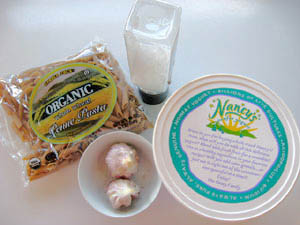
yogurt, salt, garlic, and pasta. The pasta is Trader Joe’s Organic Whole Wheat Penne, but you can use any type. The yogurt is plain Nancy’s Nonfat. Plain is important.
Next I got out my mortar and pestle and pulled some cloves from the garlic. A lot of cloves.
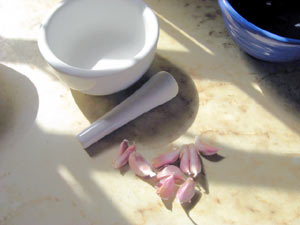
In my neighborhood garlic is planted in late fall and harvested mid-summer. That means that by late spring, most garlic has lost some of its flavor, and is softish. This garlic is a freshly harvested, very pungent rojo (red) variety. Small cloves but full of oil and hot stuff. Perfect for this dish.
Lay them on the cutting board along with your biggest and heaviest knife. Mine was hand made from an old saw blade and its blade is 8.5″ long. 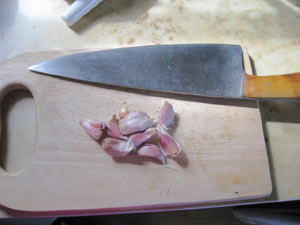 I lay it flat in on top of the garlic cloves and give the blade a thwack or two with base of my palm. This breaks the outer skins and makes the cloves easy to peel.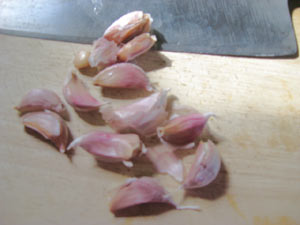
My mortar and pestle are not perfect for this job. They’re unglazed porcelain. They don’t have much bite for grinding anything other than dried herbs, but I use them anyway because they are what I have. I add the garlic cloves and some coarse sea salt and grind the heck out of them.
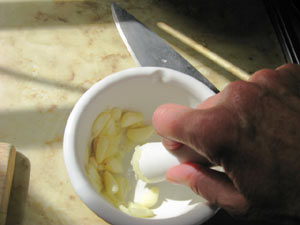
Now is the point at which enquiring minds will ask, “Why is she grinding the garlic rather than chopping or mincing it? ” And the answer is I want to smash the oil out of it, which gives it a stronger flavor. That and the oil mixes readily with the yogurt. You could also use a garlic press which crushes the cloves. You could also use a wooden spoon in a bowl, two wooden spoons nestled together, two forks and a plate . . . invent a technique using the tools you have on hand. I use this technique because this is how I learned it from a Greek lady.
Next, I put a large dollop of yogurt into a bowl, about a cup-and-a-half to two cups, [here’s another theme: I SELDOM MEASURE INGREDIENTS] and add the garlic-salt mixture: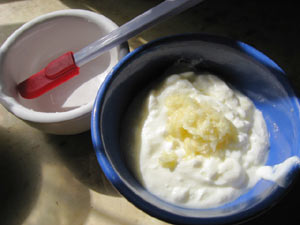 Then mix it all together with a fork or spoon or rubber spatula (or I suppose you could use your finger but it would be messy).
Next, cook your pasta per instructions on the package except you don’t need as much water as they say. I cooked the whole pound in my four liter pot a little over half-filled with water. That’s just over half the water they call for. Just pay attention and keep the lid ajar.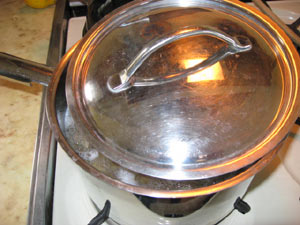 Now if I had had company here for dinner, the table would have been set, the lettuces salad made but not dressed until the last minute, and I would have combined the pasta with the yogurt sauce and served it. It would be time to eat immediately after the pasta was drained.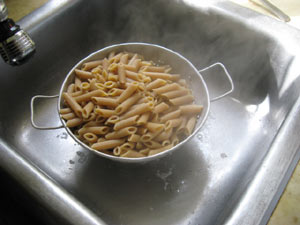
As it was, I was going to a pot luck and a Blessings sister had called an hour earlier to sing ‘Happy Birthday’ and she told me she was bringing fresh basil pesto. We decided it would be nice on the pasta as well, so I dished it out like this: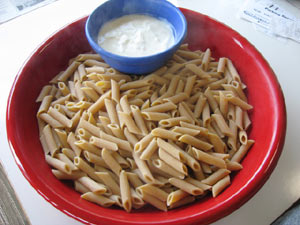
I had to drive about 20 minutes and we ate another half-hour after that but I didn’t worry. This dish does fine at room temperature.
LEARNING OPPORTUNITIES:
- Unless the Fourth Hungarian Regiment is coming for dinner, don’t cook a whole pound of penne. It makes A LOT. I made 3 to 4 times more pasta than we ate. There was a pasta salad there (which doesn’t happen too often. We never plan who’s bringing what. We all just make what we feel like making that day) and lots of other goodies including a to-die-for-from-scratch-chocolate-birthday-cake. Even after I gave away some of it, I brought over a quart home.
- Don’t mix the sauce with the pasta until you’re ready to serve it, otherwise it gets absorbed by the pasta which becomes bloated (i.e. no longer al dente) and starchy. Eeewwww. I learned this years ago but it’s relevant here.
- Can you freeze cooked pasta? None of us knew so I came home and promptly put a quart of it into a yogurt container and popped it into the freezer. I’ll let you know the results when I take it out.
- This sauce, with much less yogurt, is great medicine for a sinus infection or cold. It’s hotter than heck but safer for you, and for me more effective than, antibiotics. Serve it on crackers, hold your nose and dive in. Good (organic), fresh garlic is good medicine. I know this because my great-grandmother (and generations of my ancestors before her) was the village healer. Modern medical research is finally catching up.
p.s. It was a hit. I’d never taken it to Blessings before and most of the sisters loved it. A couple kept remarking that they never would have thought such an odd combination could be so good. That’s only because they haven’t hung out with the right old Greek ladies.