Arnica Montana . . . it belongs in your home

You need to keep these things with your first aid supplies:

Arnica Montana

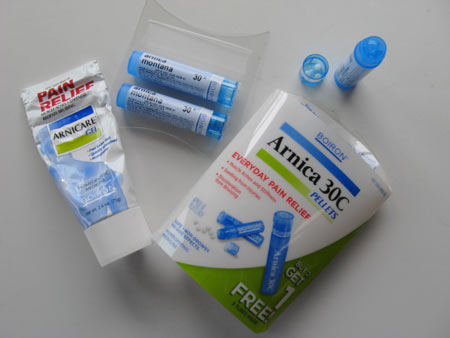
The herb is Arnica Montana and you can buy it as a gel or cream. You can also buy it as little homeopathic pellets that you put under your tongue and let dissolve (those are in the little blue tubes). I use both the gel and the pellets.

The packaging says it’s for “Everyday Pain Relief” but it’s real magic is for bruises. The faster you apply it, the better it works.

I took a headlong spill a couple of weeks ago off my steps that ended with a dead cat bounce. I lay there a minute inventorying my body to see if I could feel if anything was broken. When I got up I immediately found the arnica gel and slathered it over all the parts that hurt and the bruises that were forming. I had run out of the pellets.

I was lucky. Just a cracked rib and a number of bruises. The rib is still reminding me to be careful where I put my feet but the bruises were gone within a few days.

Seriously! This stuff works! My bruises heal in miracle time if I find them right away and use both the gel and homeopathic pellets. I’ve even had a doctor and a physical therapist comment on how quickly they heal.

Of course . . . maybe you don’t need Arnica at all because maybe you aren’t as clumsy as some people.

Onion salad??? Yep and it’s delish!!

I’d better hurry up and post this before the Walla Walla Sweet Onion season is done. These are the large sweet, white onions grown in Washington State that have been available for the past couple of months. I’ve made this salad for 4 potlucks in the last month and it has been a smash hit at every one, partly because it’s so unusual. Any sweet onion will do and this dish is drop-dead simple to make.

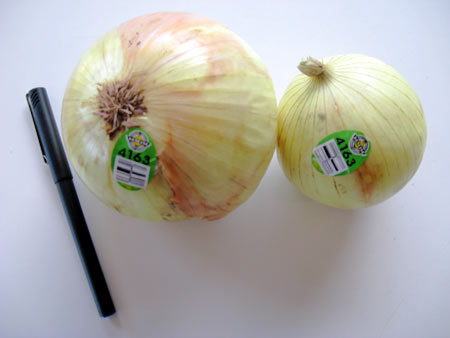
For a large bowl, potluck size, you start with a couple of onions. Notice the larger one is really big. If you’re making this for yourself, start with a single, smaller onion. Sweet onion salad 1

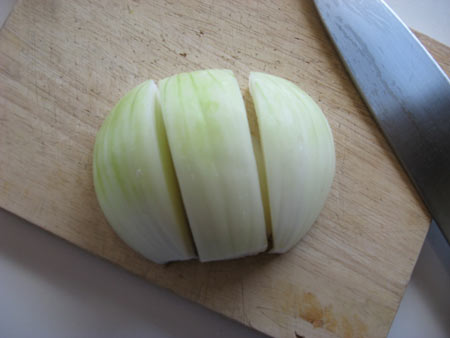
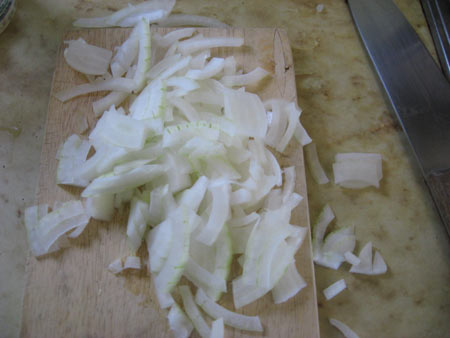
Peel and chop the onion. If you do a large or medium dice (these photos are mediumish) it’s a salad. If you chop everything finely it’s still a salad, but because it has a relish-like consistency you can serve it with crackers as an hors d’oeuvre. Great for a “finger food” event.

onionsalad2

onionsalad3

(You will note that I was not Mrs. Blair’s star pupil in 8th grade Home Economics in the “uniformly diced vegetables” department.)

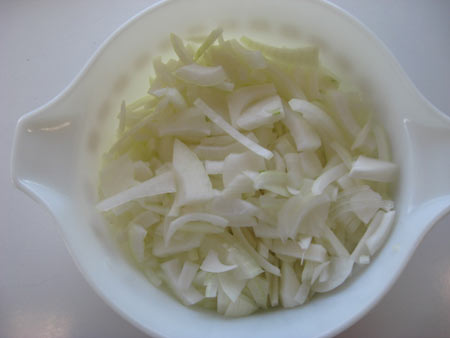
Put the onions in a largish bowl.onionsalad4

This is the first time I’ll mention bowl size but it won’t be the last. Always mix or prepare your food in a BIG bowl, much larger than the volume of the food you’re preparing. You do this because you need room to toss and mix the ingredients without them flying all over the counter and floor. This bowl is just under half-full.

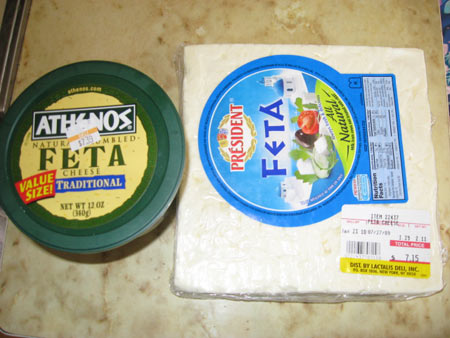
Then you add crumbled feta cheese. onionsalad5

I have to say that buying the one on the left killed me because it cost $9.85 per pound (and it was the cheapest feta at my local large grocery) versus the $3.39 per pound for the one on the right from Costco. Almost 3 TIMES AS MUCH, but the first of these potlucks was a very special occasion and I needed it right then and the nearest Costco is 45 minutes away if I go a little, a tad, maybe 10% or 15% over the speed limit in the non-speed trap stretches.

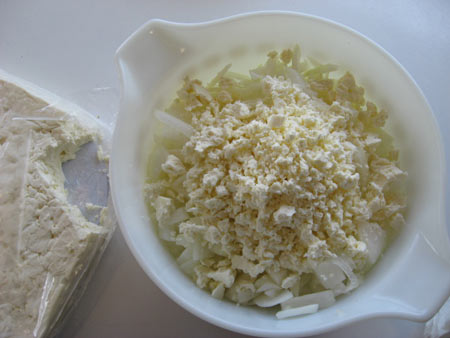
Crumble the feta with a fork and add to the onions.onionsalad6

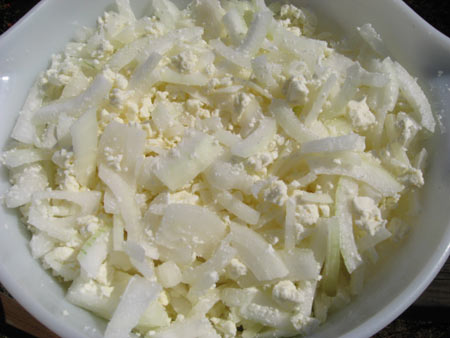
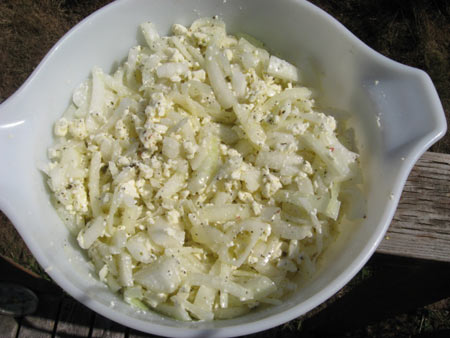
You can see that I fork-nibbled the corner of that 2+ pound block. By the time I was done I used about 8 ounces or half a pound for the amount of onions I had (those two you saw above). I determine how much feta to add by tossing it evenly and looking at it. It should look roughly like this in terms of proportions.onionsalad7

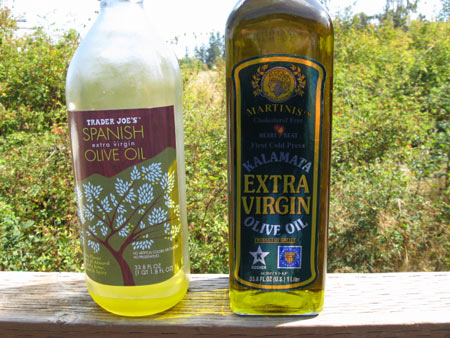
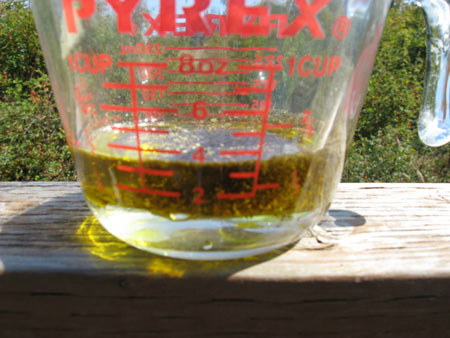
Then it’s time to make the dressing . . . once again, a vinaigrette. We start with a good extra virgin olive oil, or two in this case. I finished up the one on the left and opened the one on the right. The Spanish one on the left is lighter partly because I store it in the refrigerator once it’s open to keep it fresh, partly because it’s a lighter green oil.

onionsalad8

And here’s one of the few times I use white vinegar for food. The onions are white, the cheese is white and I want the salad to stay that way so I add white vinegar.onionsalad9

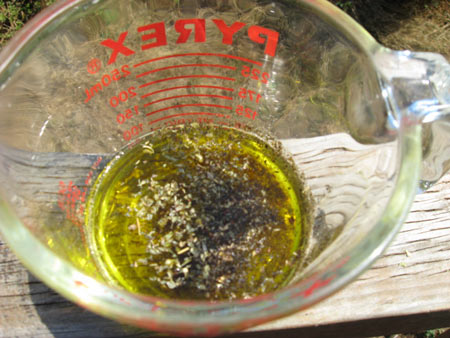
I often use a measuring cup to mix my vinaigrettes but I don’t use it to measure. Instead, I use it to eyeball the proportions. This is about 3 parts oil to one part vinegar.

Add some dried basil and dried oregano which you’ve rolled in the palm of  your hand to break it smaller and release fresh flavor.

onionsalad10

Those of you with acute perception will notice an oddity about the last two pictures and I’m not telling you what it is. Comment when you figure it out.

You don’t need to add salt. The salt of the feta is the perfect complement to the sweet, yet a-little-bit-bitey onion.

Toss the dressing with the onions and feta.onionsalad11

Let it rest for at least 4 to 8 hours. Overnight is too much. This salad wants to be made in the morning and served that evening. Somehow, that’s the perfect amount of time for the vinegar to work its magic on the onion.

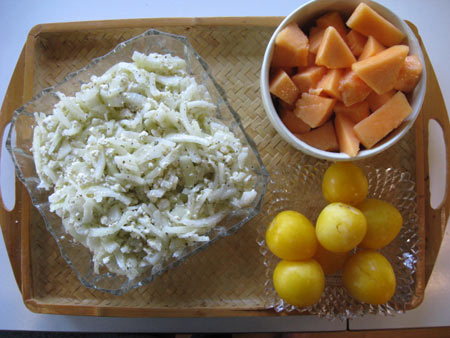
When you serve it, put it into a pretty bowl.onionsalad12

This particular tray went with me to a Blessings which always starts with a 5:30 potluck. Our spiritual work starts at 7:00 and goes until it’s time to stop, usually by 9:00. The cantaloup is a tiny, sweet variety grown by one of the island farmers. The plums are dead ripe, juicy and sweet. They would never make it to a grocery store because their ripeness cycle is short and perishable. I had picked them from a friend’s tree the day before.

My wish for you is that you are blessed with an abundance of good food and that you gather with your friends and family and neighbors to share it.

Grandma’s chicken and dumplings

I’m posting this to fill a request from someone who read The Power of Food #2 post. . . and because Grandma would be tickled by the thought of me passing it on to the world . . .

Chicken and Dumplings . . . Fegyvernek Style

For the “stew” part:
one chicken, cut up into pieces
a medium onion, yellow or other sharp variety, chopped
a little bacon fat or lard (I use an olive oil/butter mix nowadays)
parsley, fresh or dried (a couple of tablespoons if dried, twice that if fresh)
paprika (sweet, not hot, Hungarian paprika)
salt and pepper
water

For the dumplings (a large batch. You can halve this recipe.)
4 eggs
about 1½ cups of water
½ teaspoon salt
3 to 3½ cups flour

Lightly brown the onion in the fat you’ve chosen in a large pot. Then add the paprika and stir for a minute or so. Add the parsley, chicken pieces, salt and pepper and enough water to barely cover the chicken. Cover and simmer until done, about ½ to 1 hour depending on the size of your chicken pieces. Remove the chicken from the pot and put it in a bowl. Cover to keep it warm.

Add more water to the pot (an inch or so, maybe two or three if you make the whole recipe for dumplings), put the cover on and bring it to a boil as you prepare the dumplings.

Beat the eggs and salt with a fork in a plastic bowl. (You can use any bowl but it’s good if it’s lightweight because you’re going to hold it over the boiling broth as you drop the dumplings into the pot.) Add about 1½ cups water to the eggs mixture and beat again. Add the flour and beat until it has a “sticky” consistency. This is wetter than regular bread dough.

Uncover your pot of boiling broth and hold the bowl of dumpling dough just over it. Tilt it toward the pot. Dip a teaspoon into the hot broth, then go up to the bowl and scoop about ½ teaspoon full of dough and drop it into the broth. Repeat, dipping the spoon into the broth and scooping a little dough into it until all the dough is gone. Move the bowl around so that you drop the dumplings more or less evenly over the whole pot. DO NOT STIR THE DUMPLINGS YET!

Cover the pot and let it boil about 7 to 10 minutes. NOW YOU CAN STIR THE DUMPLINGS. Cook them for another 5 to 10 minutes, add the chicken back into the pot and reheat it for a few minutes. You’re ready to serve. (I like to sprinkle on a little fresh parsley at the end, but Grandma didn’t do that.)

Family food feud

When my dad was alive (he died in 1959) we didn’t eat these at my house. He called this style of  dumplings “bullets” and wasn’t having any of them. As a French-Canadian, he knew dumplings as fluffy clouds that floated over beef stew. But I ate them every time I stayed at Grandma and Grandpa’s and that was often. My mother deferred to Dad’s tastes and always made him his fluffy, with-baking-powder, favorites, and always over beef, not chicken, stew.

I’m not sure why but I never asked Ma how to make fluffy dumplings. But I learned, as a very young girl, how to make bullets because I loved them. In that wonderful alchemy of genetic stew that makes a baby, I ended up with straight blonde hair and blue eyes. My dad had wavy brunette hair and hazel eyes. I adored him . . . but I’ve always loved the bullet dumplings best . . . and I never halve the recipe.

Getting Real About the High Price of Cheap Food

This article was sent to me by a Blessings sister. Please . . . read it. This is not about economics (though it is). This is about the survival of our species. I’ve been following this subject for over 40 years and I’m grateful that it’s finally coming into the consciousness of popular media.

Getting Real About the High Price of Cheap Food

Every time you put a piece of food in your mouth you are making a choice. Every time go to a restaurant or fast food place you are making a choice. Every time you buy food or drink at a grocery or other store you are making a choice. You have more power than you know.

Please . . . read it.

Dense salads . . . 100 ways or more

Autumn is coming on fast even though it’s supposed to get to 90º in Salem OR today and I am both home and wearing shorts. This happens only about 12 days a year and usually for less than 6 hours each of those days. Call me Milk Legs. And as the weather gets colder I switch from dense salads in the fridge to soups so I’d better finish up this thread for the season.

Congratulations on making chicken salad or it’s fancied up sister, curried chicken salad. These are among the more challenging of dense salads because you have to cook the chicken. If you tried one of them, everything else will be a snap for you.

There are hundreds of dense salad variations. All you need are “solids” cut or broken into bite-sized pieces or smaller and a dressing to bind them together. I never measure amounts for these. I just put in what looks good or what I have on hand or enough to take for a crowd or enough to last me a few days. Here are some combos I make (and I’m starting again with basic chicken salad because I’m a teacher. “Tell them what you’re going to tell them. Tell them. Then tell them what you told them.” Multiple exposures work.)

BASIC CHICKEN (OR TURKEY) SALAD
cooked chicken breast
celery
red or green onion
a tart, crisp apple
Dressing= a little cottage cheese mashed with the back of a spoon in a small bowl until smoothish and add a little milk to it. (or whirl it in a small blender). You could also use a good mayo or yogurt cheese.

CURRIED VARIATION
To the above solids add some raisins or dried cranberries, currents or cherries. Frozen peas that have just been thawed and drained are also great to add. To the dressing add some curry powder. (This one really impresses people. Good for a pot luck or someone coming for lunch.)

BASIC TUNA SALAD
tuna from a can, broken up
celery
a little onion
dill relish
Dressing=mayo

SALMON VARIATION
Same as above except with salmon. I use leftover cooked salmon or Trader Joe’s
canned Wild Alaskan Pink Salmon which is a great value. I keep it in the larder.  And instead of dill relish I add capers.

COMPANY TUNA VARIATION
Same as the basic but make sure you have albacore tuna (all I have around anyway) and add sliced hard boiled eggs For this I cut everything a little bigger  and mix very lightly. Dressing = vinaigrette made with a light-colored vinegar

Beyond these fish and fowl combinations there are grain, legume, and pasta variations. Choose 1 or 2 from Column A (all should be cooked before putting them into the salads), 3 or 4 or 5 from Column B, and a vinaigrette.

Two things:

  1. This chart doesn’t have everything on it. It’s just a place to get you started.
  2. You could choose 5 or 4 things from Column B, skip Column A and be done with it.
Column A Column B Vinaigrette
-brown rice
-wild rice
-pasta (any kind from whole grain to rice noodles, and there are lots of fun shapes)
-bulgur
-lentils
– beans (black, white, red, garbanzos etc. canned and rinsed makes this an easy add. If you make them from scratch it’s cheaper and don’t overcook them)
-quinoa (KEEN-wah)
-red or green onion
-celery
-carrots
-broccoli
-cauliflower
-sweet peppers (green, red, orange)
-mushrooms
-peas (thawed if frozen)
-corn (thawed if frozen)
-fresh parsley
-fresh cilantro
-nuts (almonds, walnuts, cashews, pecans, etc.)
-green beans (lightly steamed)
-grapes
-apple
-cucumbers
-tomatoes
-jicama
-raisins or other dried fruit (e.g. cranberries, currants or blueberries)
BASIC RECIPE
-1/3 to ½ cup oil
-1 to 3 Tbsp acid (vinegar or lemon or lime juice)
-salt and pepper
-herbs and spices of choiceand usually, one or more of the following:
-finely minced aromatics (garlic, scallions)
– stone-ground mustard
-a tsp of sweetener (sugar, honey, maple syrup, ginger syrup)

Put it all in a small jar (pint or so) with a screw-on top and shake it up.

THE VINAIGRETTE
So easy, fast, cheap and delicious that I forget why we have bottled dressing. Even mayonnaise is a variation of it: acid plus oil with a few seasonings.

The Acid
I just checked my stash. I have 5 kinds of vinegar: balsamic, rice, red wine, apple cider, and sherry.Vinegars
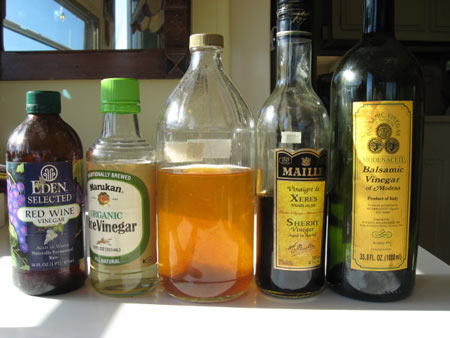
I keep a sixth type, white distilled vinegar, under the sink for cleaning but I don’t use it in food very often. Vinegar keeps forever in the cupboard. If I had to choose only one it would be organic apple cider vinegar. Balsamic is very distinct in flavor and it would be my second choice. Lemon or lime juice (freshly squeezed) are fresh-tasting and lively and can be used alone or combined with vinegar or one another.

The Oil
I have 5 types on hand: extra virgin olive oil, canola, toasted sesame, chili oil and coconut, all in the refrigerator except for the coconut which is solid at room temperature and a few ounces of the olive oil in a little dispenser bottle on the counter because it’s my everyday oil.Cooking oils
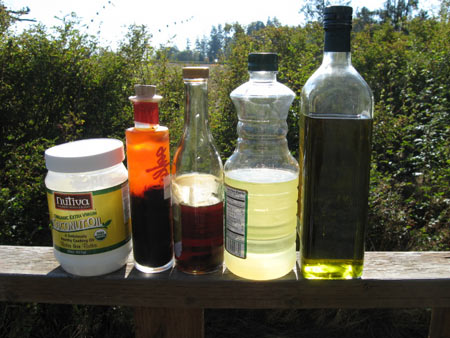
The canola (which is basically flavorless) is for baking or for part of a vinaigrette oil. I use the coconut oil (organic) primarily as a nighttime hand and face cream. I have a small jar of it next to the bed that I refill from the big jar. It’s incredible! Cheap, cheap, healthy, absorbs into the skin quickly and smells clean and wonderful. It’s also good for stir fry, especially Thai or other Southeast Asian-style dishes. The toasted sesame oil is both perishable and very strong. I use it in oriental style stir fries sometimes and in some marinades. The chili oil is VERY FIERY. I use only a drop here and there in a dish if I want to heat it up without changing the other flavors.

The standard ratio of oil to vinegar or acid is 3 to 1: 3 parts oil, 1 part acid. But you can vary that according to your taste. You might try 2:1 or 4:1. Experiment. You can see pictures of the process of making a lemon vinaigrette in “A refreshing slaw.”

A couple of tried and true salads to inspire you.

DARCY’S FAVORITE DENSE VEGGIES
broccoli
grapes (red are the prettiest. I cut them in half)
celery
bacon bits (a few crisp strips crumbled or the already cooked ones)
red onion
almonds
Dressing: small amount of mayo or vinaigrette

FAVORITE PEA SALAD THAT’S EXPENSIVE IN THE DELI
big bag of frozen green peas, thawed and drained
red or green onion
bacon bits (again, real, crumbled, crisp bacon. I know it’s not great for health but I don’t eat slabs of it, I’m not a food Nazi and I was raised by Austro-Hungarians. That and Norwegian Great-Uncle Art used to smoke bacon especially for us but that’s a story for another day.)
small cubes of cheddar (Optional, but then everything is for these salads. They tend to sog up a little after a day in the fridge.)
Dressing = a little mayo

The purpose of this post was, once again, to have you start thinking differently about food preparation. You don’t follow a “recipe.” Instead, you learn a technique (like roasting veggies), play with it a few times, and it becomes your skill that you can use without even thinking.

Quick! look in your fridge. What combination can you create today? Now do it. You can’t “make a mistake.” It’s just food, not dynamite.

Roasted “spaghetti sauce”

Rarely am I inspired to invent a new dish but it recently hit me one night. I love roasted veggies, and I love pasta so what if I . . . ? And thus “roasted marinara sauce” was born.

Marinara is the tomato-based sauce we think of as typical spaghetti sauce. When I lived with the boys I simmered vats of it on the stove and it went into lasagne and onto various kinds of pasta.

But I realize, I’m not that fond of regular spaghetti sauce. Some of it is better than other of it, and every once in a while I’ll make a batch of chicken cacciatore (here’s a simple and typical recipe) and freeze it in single portions so that I can have a quick hit of Americanized Italian, but I don’t cook it for a regular meal.

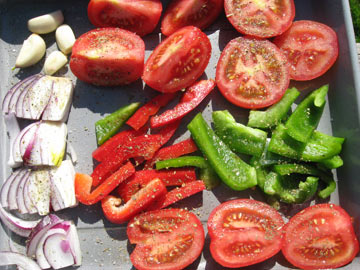
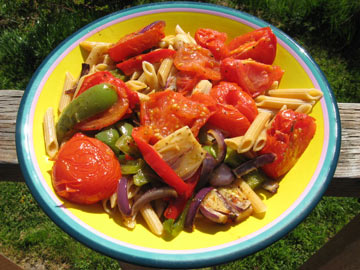
So here was my thought. Take the veggies you normally put into spaghetti sauce and put them in your roasting pan:  garlic cloves, onion (red in this case because it’s what I had “open” in the fridge), tomatoes and red and green bell peppers. Sprinkle them with a little dried oregano and basil as well as salt and pepper. Don’t forget the olive oil.Roasted-marinara-1

(Notice the wonky tomato cutting. I was experimenting so I cut one in slices the long way, one in crosswise slices and I quartered the third one. I’m pointing this out so you’ll gain confidence. There’s no one “right” way to do it. Just keep the pieces roughly the same size. Very roughly.)

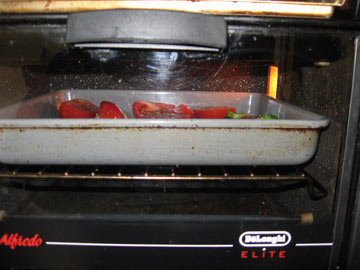
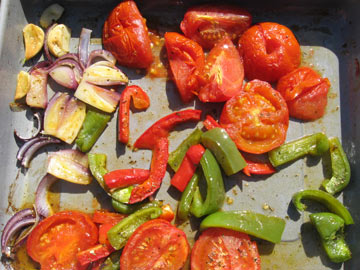
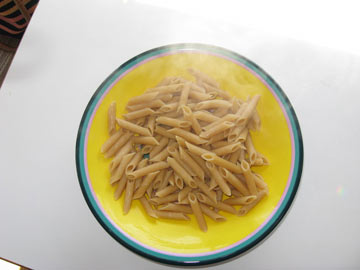
Then roast them just as we did for regular roasted veggies.Roasted-marinara-2When they’re done they look like this.Roasted-marinara-3And while they were roasting, I cooked and drained the pasta (whole grain in this case) and put it in a beautiful bowl made by a local artist.Roasted-marinara-4

I timed it pretty well. It takes about 10 minutes for the pasta to cook and I don’t know, 5 or so minutes for the water to boil. I didn’t pay attention to this part. I just sort of know how to make it come out at the same time after much experience but you can wait 8 or 9 minutes after you get the veggies roasting to start the water. Depends on the speed of your stove, the type pot you use, etc. You’ll get the rhythm of it just by paying attention.

Then I tossed it together.

Roasted-marinara-5

CAUTION: THIS CAN CAUSE WEIGHT GAIN IF YOU’RE A LITTLE PIGGY. It was so wonderful that I ate 2/3 of it at once and it was about four healthy-sized servings. 

It’s best to invite a hungry friend to help save you from gluttony. Or at least that works for me.

Roasted veggies once a day . . .

Fresh vegetables are everywhere right now. Summer squash, cabbage, green beans, peppers sweet and hot, broccoli, tomatoes, beets, new potatoes, garlic, onions, corn, cukes, turnips . . . it’s happy high harvest season on the island and at your local produce stand. And what to do with all this bounty? Roast ’em.

Singing the praises of roasting veggies

  1. It’s a simple technique.
  2. It can be applied to dozens of different kinds of vegetables.
  3. You can do it in a toaster oven.
  4. It brings out the best in every vegetable. Delicious!
  5. It’s fast.
  6. It’s foolproof.
  7. Once you do it 3 or 4 times, it will become second nature for you.

The Process

  1. Prepare the particular vegetable by washing and drying (or shaking the water off of it), peeling if necessary, and chopping into fairly small pieces. (Don’t worry. There are lots of pictures to follow this explanation.)
  2. Put them in a pan and drizzle with a GOOD extra virgin olive oil. Dust with salt and pepper.
  3. Swirl them around in the pan to spread out the olive oil and coat the veggie pieces better.
  4. Put in toaster oven (or regular oven if you have a bigger pan and family) and roast at 425º for about 20 to 25 minutes. After about 15 minutes, remove the pan and stir and flip the veggies around a bit and put it back in until they’re “done.”

Some illustrations

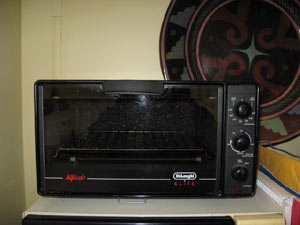
Your basic tool besides a sharp knife or two and a cutting board is an oven. I live alone for now and use my trusty toaster oven. toasterOvenforwebIt’s pretty good sized and the pan that came with it, which you will see over and over, is about 9″ by 10″.

Then you need the three essential condiments:

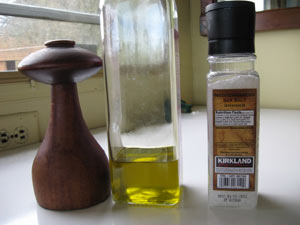
  1. Extra Virgin Olive Oil. I don’t care what brand (though Spectrum and Trader Joe’s have some great ones). I buy what’s on sale before I run out and have the new bottle in the cupboard. My favorite is First Cold Press and organic. Whatever you buy for this should be a deep, flavorful green. It’s expensive compared to other oils, yes, but it’s a great value and it will make the quality of your food soar for a small investment. A little goes a long way.
  2. Salt . . . sea salt or kosher salt. These are real. The common, pourable “table salt” has other chemicals in it. Again, a little more expensive, but important for quality and health.
  3. Pepper . . . freshly ground. As in, you should have a pepper mill. I bought mine in the Dansk store in Copenhagen in 1970. It still works smoothly and gracefully. Always buy the best quality tool you can afford. 
    Roasted Veggie Essential Condiments

I’ve told you before that there are dozens of online movies and illustrations to show you how to clean an onion or mushroom and I don’t want to duplicate that. I want to get you thinking about preparing food in a “global” way rather than thinking that you need to follow a recipe.

Roasting veggies is a technique that can be applied in a bajillion ways. Here are some examples to whet your imagination.

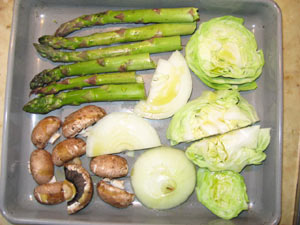
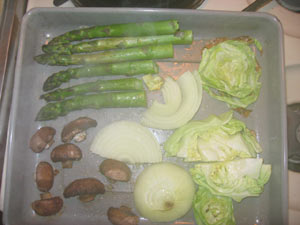
In Spring, mid-April, asparagus is in season. Crimini mushrooms (baby portabellas), onions and cabbage are always available. Notice the olive oil drizzled on top.Asparagus+ veggies in spring

I stuck this pan into the oven set at 425º.

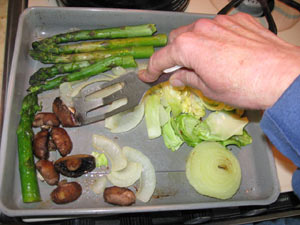
After about 15 minutes I took it out. Notice that there is steam coming off of it (fresh veggies have a high water content). The cabbage has begun to turn brown around the edges and the mushrooms have shrunk a lot.Asparagus+ at 15 minutes

Then I stirred and flipped it a bit, and put the pan back into the oven.

Stirring-the-Asparagus+

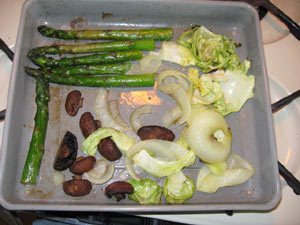
About 10 minutes later I had roasted veggies.Asparagus+ finished roasted veggies

Here are more before and after pictures . . .

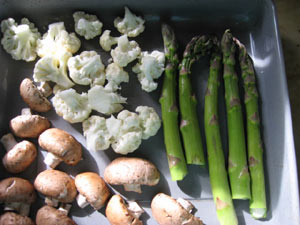
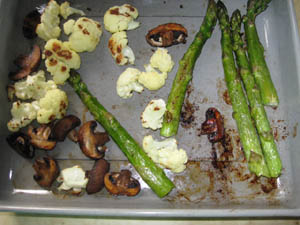
Asparagus+criminis+cauliflower beforeAsparagus+Crimini+Cauliflower Beforeand after.


Asparagus+crimini+cauliflower after roasting
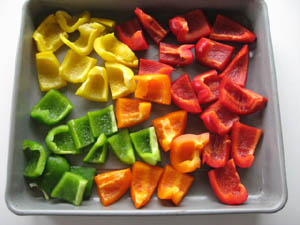
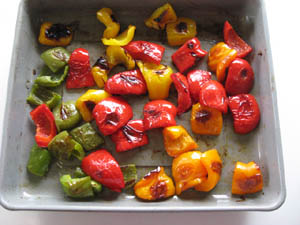
In May peppers were on sale for a dollar each. Beforeroast peppers beforeand after.roast peppers after

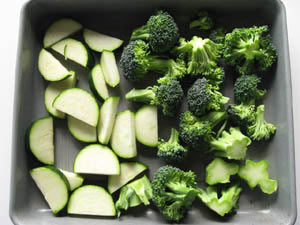
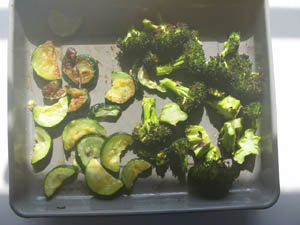
Here are zucchini and broccoli.Zucc+-brocc beforestill steaming . . .Zucc+-brocc after

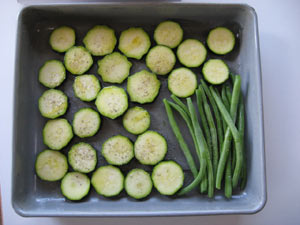
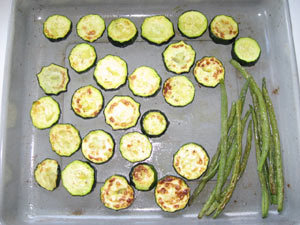
Zucchini and green beans. Note the pepper. I was in a peppery mood that day.Zucc+green beans-beforeZucc+green beans-after

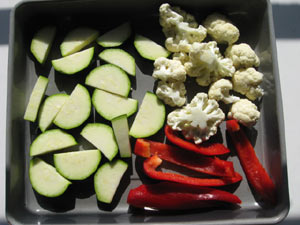
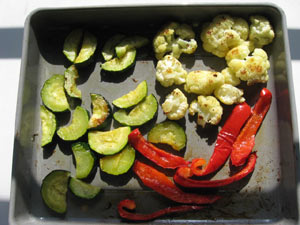
One more combo: zucchini, cauliflower and red pepper.zucch,-caul,-red-pepper beforezucch,-caul,-red-pepper-after

Enough already!

. . . with the pictures. I have successfully roasted everything you see above plus carrots, eggplant, tomatoes, potatoes, turnips, sweet potatoes, black radish, and some I’m sure I’ve forgotten.

I started doing this only about a dozen years ago with potatoes, garlic and fresh rosemary and I fell in love with them. Because I’m basically a lazy cook, I eat roasted veggies 5 to 7 days a week as one of my meals.

If you don’t like canned or “boiled” vegetables, it’s a sign of your good taste. Now try these. I’m serious! If you’re still skeptical, start with the potatoes with big fresh garlic chunks or whole cloves and fresh rosemary if you have it. To die for . . .

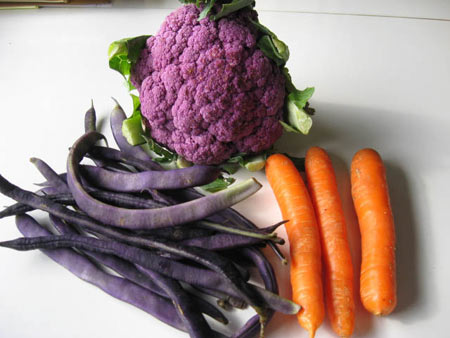
I have to go. A gorgeous purple cauliflower is calling my name. She asked me to hook her up with the purple pole beans she met in the fridge. I’m throwing in a couple carrots to chaperone. ARE THESE THREE NOT GORGEOUS? purple-caul-web

In food, as in all things, beauty counts.